
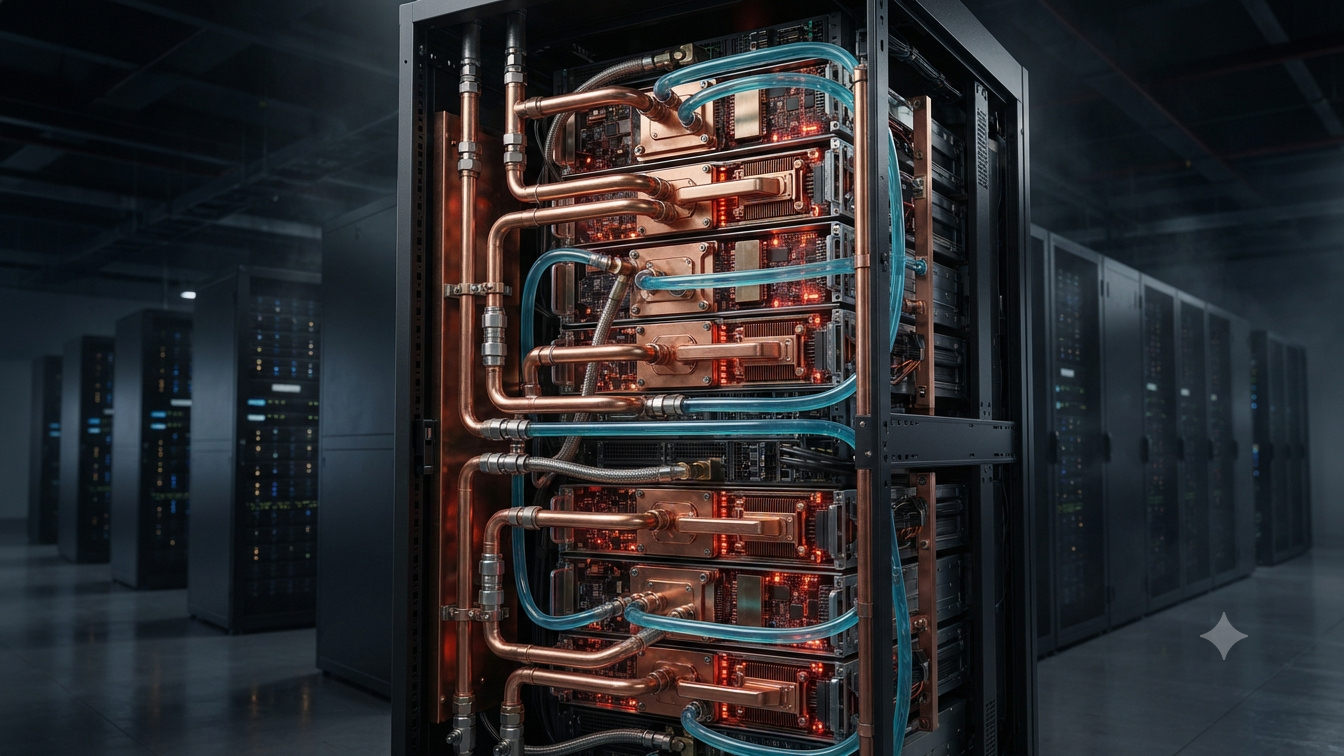
Picture an ordinary metal cabinet roughly the size of a kitchen refrigerator. Now imagine cramming 95 room heaters inside it and turning every single one up to full blast. Within minutes, the plastic would warp, the wiring would liquefy, and the whole cabinet would turn into a glowing furnace.
That might sound like an exaggeration, yet it is the exact challenge unfolding inside modern artificial intelligence data centers right now.
When most of us think about AI, we picture lines of code, smart algorithms, and sleek chat apps. Almost nobody stops to think about the physical hardware humming behind the screen. However, as AI computing reaches extreme levels—like in the new NVIDIA GB300 server racks—keeping the system running stops being just a computer science problem and becomes a massive mechanical engineering challenge. Without serious physical cooling, no AI model on earth can work.
Based on insights from Dr. Vipin Kumar Titariya, a mechanical engineering educator and researcher with more than 17 years of experience, here is a plain-English look at why AI data centers are overheating—and the clever engineering keeping them alive. (You can also watch the full Hindi video breakdown on Mechanical Insight here: 95 Room Heaters in 1 Fridge? How Mechanical Engineering Is Saving AI.)
How AI Racks Grew Over 15 Times Hotter
Not long ago, cooling a server cabinet was fairly straightforward. Older server racks—about the same physical size as the ones used today—produced roughly 9 kilowatts of heat, comparable to running six room heaters. Large fans and standard air conditioning units cleared that heat easily.
Today’s AI hardware has completely rewritten the rules. A single modern NVIDIA GB300 rack generates a staggering 142 kilowatts of heat—equivalent to those 95 room heaters packed into one cabinet. Inside that tight metal box sit 72 Blackwell Ultra GPUs and 26 Grace CPUs. Each individual GPU pushes out 1,400 watts of heat on its own, which is double the heat output of the previous generation.
Why Engineers Can’t Just Spread the Chips Apart
At first glance, the easiest fix seems obvious: if these chips run so hot, why cram them all into one cabinet instead of spreading them across five separate racks?
Think of a large symphony orchestra. If every musician sat in a different city to play the same song, the tiny delays between them would completely ruin their timing. AI chips face the exact same synchronization issue.
To run massive AI models, these GPUs cannot work solo—they have to act together like one giant supercomputer. To keep them perfectly in sync, engineers connect them using short copper cables called NVLink. Spreading the chips farther apart forces a switch from copper to fiber-optic cables. Converting electrical signals into light, sending them across optical fibers, and converting them back into electricity causes microsecond delays—known as latency—that throw off the AI’s timing. Worse still, those conversions burn thousands of extra watts of electricity just moving data from one place to another.
To keep AI fast and stop wasting power on data transfer, engineers have no choice: the chips must stay packed closely together.
Why Giant Fans Can’t Cool Modern AI Anymore
If the chips have to stay packed together, why not just install bigger industrial fans and blast colder air over them?
The problem comes down to how air and water handle heat. Water is roughly 800 times denser than air, and it can soak up four times more heat. Put those two advantages together, and for the same amount of space, water can carry away roughly 3,500 times more heat than air.
Trying to cool a 142-kilowatt rack using only air would mean creating a literal hurricane inside the cabinet. On top of that, pushing air faster gets wildly inefficient very quickly: simply doubling the speed of the airflow forces the fan motors to draw eight times more electricity. It quickly turns into a losing battle—like setting up fans so huge to put out a fire that their own motors overheat and start a new one. Once a rack crosses roughly 40 kilowatts, traditional air cooling hits a hard wall.
Bringing Water Straight to the Chips (And a Surprising Twist)
Since cooling the air in the room no longer works, engineers decided to catch the heat right where it starts using Direct-to-Chip Liquid Cooling.
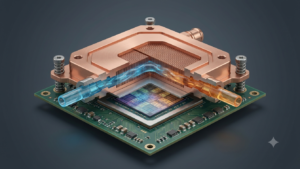
Each GPU and CPU is topped with a thin heat-conducting layer and a copper cold plate. Instead of regular wide pipes, the inside of that copper plate is carved with hundreds of hair-thin channels. Flowing water through these microscopic pathways increases the contact area between the copper and the water hundreds of times over, pulling 1,400 watts of heat off a chip almost immediately and carrying the hot water away to a cooling unit.
Even so, air conditioning has not disappeared from data centers. Many people assume liquid-cooled racks are 100% water-cooled, but the reality is closer to a 90-to-10 split:
-
90% goes into water: Copper cold plates absorb about 128 kilowatts of heat directly from the main chips.
-
10% still goes into the air: Circuit boards, memory modules, and heavy power supplies cannot all be fitted with copper plates, so they still release roughly 14 kilowatts of heat into the room air.
Pause and look at that number: just the leftover 10% of air heat from one modern AI rack (14 kilowatts) is still hotter than an entire legacy server rack (9 kilowatts). Air cooling is not gone—it has simply taken on a new supporting role.
Three Wild Mechanical Challenges Inside an AI Rack
Pumping water straight through millions of dollars of live electronics is no simple plumbing job. Engineers have to juggle three major headaches at once:
-
Warm water creates intense pressure: To save electricity and avoid running massive chillers, data centers prefer using 45°C warm water instead of 25°C cool water. Because warmer water cannot soak up heat as easily, the system has to pump it three times faster—jumping from 59 liters per minute to 177 liters per minute. Pushing water that fast multiplies internal friction eight to nine times, causing the pressure drop across the system to skyrocket from 2.3 PSI to 18.4 PSI and putting heavy strain on the pumps.
-
300 water joints right next to high power: A single GB300 rack contains 280 to 310 quick-disconnect water fittings. Those hundreds of pressurized connections sit directly behind the rack, right beside a massive power line carrying 192 kilowatts of electricity. Since a single stray drop could cause a catastrophic short circuit, racks rely on a three-layer leak detection system—monitoring the chip tray, the water manifold, and the floor—that isolates the problem and cuts power within microseconds if even one drop falls.
-
A full-size car on half a dining table: All those copper plates, steel pipes, power shelves, and circulating water make one fully loaded rack weigh roughly 1,580 kilograms—the weight of an entire sedan car. Worse, all that weight rests on a tiny footprint smaller than half a dining table (600 by 1,068 millimeters), pressing down with roughly 500 pounds per square foot. Without careful structural testing and reinforced concrete floors, the rack would punch straight through into the basement.
The Big Payoff: 21% Faster AI Without Changing a Single Line of Code
With heavy-duty pumps, microsecond leak sensors, and reinforced floors, is all this effort actually worth the cost?
Data centers measure energy efficiency by comparing the total electricity entering a building against how much of it actually reaches the computer chips. In older air-cooled facilities, roughly 40% of the electricity goes to waste just running fans and air conditioners. In modern liquid-cooled buildings, cooling overhead drops to just 10%, leaving 90% of the power free to do real computing work.
The biggest surprise, though, is what happens to AI performance. Because liquid cooling keeps the chips much cooler, they suffer less electrical power leakage and process data faster. The result is roughly 21% more AI output per watt of electricity—without writing a single line of new software or swapping out a single chip. Better mechanical engineering alone makes AI noticeably faster.
Turning AI’s Heat Into Winter Warmth for Cities
All of this leaves data centers with an enormous supply of 45°C warm water carrying 128 kilowatts of heat away from every single rack. Usually, facilities just release that heat into the outdoor air through cooling towers.

Some Nordic countries, however, are already turning that waste into a community asset. Instead of throwing the heat away, they pipe warm water from data centers directly into local heating networks to keep residential homes warm during freezing winters. Those 95 room heaters locked inside a metal cabinet might not just power the future of artificial intelligence—they could help heat entire neighborhoods along the way.
Computer science may be building the brain of modern AI, but as Dr. Titariya’s research makes clear, everyday mechanical engineering is what keeps that brain cool, steady, and alive.
https://www.youtube.com/watch?v=0VFk6GKZ_k0